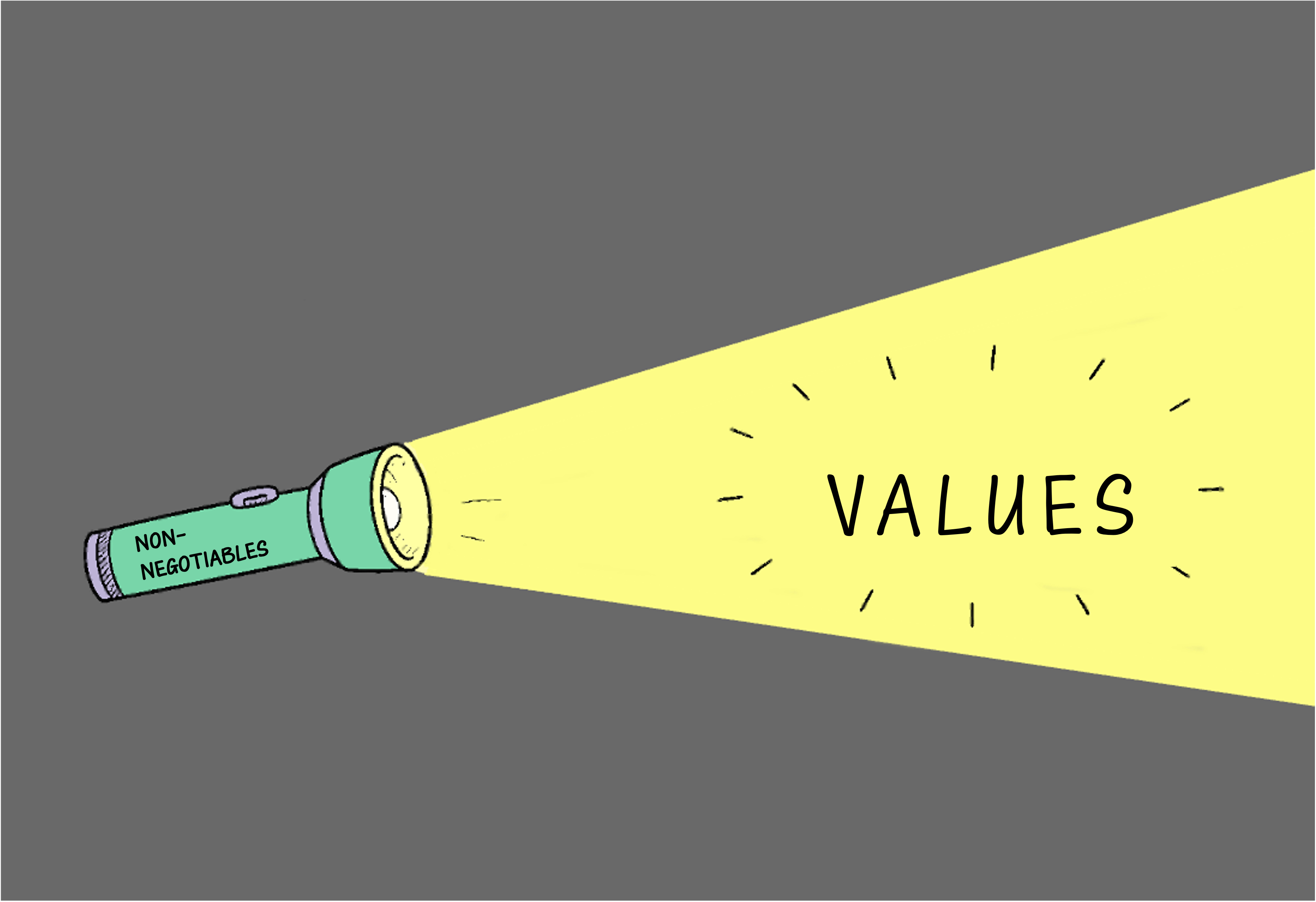
Most companies have ‘values’ on their website. If you’re lucky, employees might be able to tell you what they are.
The challenge isn’t to come up with platitude-soup terms like ‘excellence’. It’s to find out which words authentically represent the company culture.
I was recently with an HR Director of a large company who described their values as ‘wallpaper’. And they were literally just that. They were on posters on the walls, but bore no relation to employees’ lived experience.
Why define your values?
Are there meaningful benefits to defining your values, or is it just a tick-box exercise?
In short: yes, values matter, but only if they’re real.
When a company has a shared understanding of what it genuinely stands for, and a shared language for expressing that, it becomes much easier to tell a consistent story.
Why? Well, inside the company, people will have a clearer sense of what you’re trying to achieve and why. And crucially it’ll become easier to know how you’ll work together to achieve them - what behaviours are encouraged… and which aren’t. This is particularly important for growing companies trying to bring in an influx of new starters while keeping their core cultural values intact.
Externally, will customers hear a message that feels authentic because it’s rooted in real beliefs rather than standard marketing bluster.
Perhaps more importantly, values can become a useful filter for decisions.
They help you ask questions like:
- ‘Is this the kind of client we want to work with?’
- ‘Does this objective move us in the right direction?’
- ‘Is this behaviour what we want to encourage?’
- ‘Does this candidate feel like they’ll thrive here?’
None of these questions has a single correct answer. But having an explicit set of values gives people a common language. Often the most difficult decisions – letting an employee go, turning down a contract – are easier to discuss through the lens of this agreed understanding.
Finding authentic values
Often something becomes easier to define by being clear about what it doesn’t include.
Drawing on this idea, one of the most interesting exercises I use in positioning workshops starts with a simple question:
“What would you not be willing to compromise?”
Once people move beyond the obvious (“we don’t want to enable fraud” type of thing), they start telling stories. In a recent workshop, for example, team members used examples to outline how they wouldn’t sacrifice one client’s interests for the sake of another client; how they would support instead of blame each other when there’s a problem; where they would rather walk away from a potential contract than compromise their ethics.
The exercise gave real insights into how this particular company thinks. And where there were the examples that had lots of nodding and others adding or chipping in, that’s where most was revealed about underlying shared values.
Every organisation has moments where compromises are necessary: profit, speed, convenience, growth, relationships. But the choices made in those moments are also the most illuminating… Which compromises feel acceptable, and which would be a step too far? The question uncovers something important, in pinpointing the things people genuinely protect.
So what’s non-negotiable for you?
To be clear though, values aren’t about choosing principles instead of success. They’re about deciding how you’ll achieve success, and what you’re unwilling to sacrifice to do it.
Thinking properly about what your non-negotiables are, and hearing from colleagues about whether those are truly shared, gives you a window into what matters most in your culture and should be the basis for values that really represent your company.
And here’s how not to do it
An abstract lesson in how not to identify your values, from the beleaguered character Ian Fletcher, Head of Values, in this beauty of a scene from BBC comedy W1A…